Tuesday, September 11, 2012

People's Car - Golf Mk2 (1983–1992)

         
       September 1983 saw the introduction of the second-generation Golf Mk2 that grew slightly in terms of wheelbase, exterior and interior dimensions, while retaining, in a more rounded form, the Mk1's overall look. In 1985, the first Golfs with four-wheel-drive (Golf syncro) went on sale with the same Syncro four-wheel-drive system being employed on the supercharged G60 models, exclusively released on the continent in 1989 with 160 bhp (120 kW) and ABS braking.A Mk2-based second generation Jetta was unveiled in January 1984. There was no Mk2-based cabriolet model; instead, the Mk1 Cabriolet was continued over the Mk2's entire production run.


Volkswagen Golf 2 (Mk2)


Volkswagen Golf 2 (interior)

The Golf Mk2 was available as a 3- and 5-door hatchback. Its sedan sister car (available as a 4- and a 2-door model) was again called Jetta. No cabriolet version was developed from the Mk2; instead, the Mk1-based convertible continued to be produced, with minor changes. 

Universal Red Mk2 - aka Golf 2

Volkwagen Mk2 - Golf 2 Country (all-road)

There was also a version called Golf Country (3,000 cars), designed for light off-road driving. It had more suspension travel, four-wheel drive, bullbars (generally over a single headlight grill), a skid plate for protecting the engine area, and a spare wheel mounted externally on the back.
In Europe, it was offered with the acclaimed 114 bhp (85 kW) 1.8 8v petrol engine. There were also: 160 "Country Allround"; 558 " Country - Chrompaket" with Chrome bullbars and beige leather interior; and 50 "Country GTI" for VW-staff. The Golf Country was particularly popular in Alpine regions in.


Volkwagen Golf 2 GTI

The successful Golf GTI (or, in the USA, simply "GTI") was continued with the Mk2 as a sporty 3- or 5-door hatchback. Like late Mk1 GTIs, it featured a fuel-injected 1.8 litre four developing 112 PS (82 kW; 110 hp). In 1986 (1987 for North America) a Golf GTI 16V was introduced; here the 1.8 litre engine put out 139 PS (102 kW; 137 hp) (or 129 PS (95 kW; 127 hp) for the catalyst version) and the model was marked by discreet red and black "16v" badges front and rear. US/Canadian GTIs were later equipped with 2.0 16 valve-engines, available in the Passat and Corrado outside North America. In 1990, like the Golf, the GTI was given a facelift, and the "Big Bumper" became standard on all GTIs. This was maintained through the rest of the Mk2 model era. In 1990 the GTi G60 was also introduced featuring the 8v 1.8 with a G60 supercharger this version is not to be confused with the very rare G60 Limited.


Rallye Golf MK2


In 1989, the Rallye Golf appeared as a rallye "homologation special". Distinguishable by its box-flared wheel arches (similar to the Audi quattro, BMW E30 M3 and Lancia Delta Integrale) and rectangular projector headlamps, this model featured Syncro four-wheel drive, a cable shifted transmission and a G-supercharger 1763 cc (less than the typical 1.8L 1781 cc to meet the engine displacement rules) version of the injected 8 valve G60 1.8 liter engine.

5,000 cars were built in Volkswagen's Brussels, Belgium, plant, priced at about DM 50,000 each (or roughly twice as much as a base Golf GTI). The Rallye Golf has 161Bhp (118 kW).[7]

None were officially sold in the USA. Two were brought over officially for testing and when the Pan-Am Lockerbie Scotland bombing occurred the Volkswagen of America (VWOA) official that was in favor of selling them died, so did the hope of the these being sold in the USA.


People's Car - Golf Mk1/Rabbit (1974–1983)

In May 1974, Volkswagen presented the first-generation Golf as a modern front-wheel-drive, long-range replacement for the Volkswagen Beetle. Later Golf variations included the Golf GTI "hot hatch" (introduced in June 1976), a diesel-powered version (from September 1976), the Jetta notchback saloon version (from October 1979), the Golf Cabriolet (from January 1980) and a Golf-based pickup, the Volkswagen Caddy.

The Golf Mk1 was sold as the Volkswagen Rabbit in the United States and Canada and as the Volkswagen Caribe in Mexico.

A facelifted version of the Golf Mk1 was produced in South Africa as the Citi Golf from 1984 to 2009.


                                                                  Volkswagen Golf Mk1

People's Car - Volkswagen Golf

     The Volkswagen Golf is a small family car (C-segment in Europe) manufactured by Volkswagen since 1974, marketed worldwide across six generations, in various body configurations and under various nameplates – as the Volkswagen Rabbit in the United States and Canada (Mk1 and Mk5), and as the Volkswagen Caribe in Mexico (Mk1).

The original Golf Mk1, designed by the Italian Giorgetto Giugiaro, was a front-wheel drive, front-engined replacement for the air-cooled, rear-engined, rear-wheel drive Volkswagen Beetle. Historically, the Golf is Volkswagen's best-selling model and the world's third best-selling model, with more than 29 million built by 2012.

Most production of the Golf was initially in the 3-door hatchback style.[2] Other variants include a 5-door hatchback, estate/wagon (Variant, from 1993), convertible (Cabriolet and Cabrio, 1979–2002), and a Golf-derived notchback saloon/sedan, variously called Volkswagen Jetta, Volkswagen Vento or Volkswagen Bora (from 1979). The cars have filled many market segments, from basic personal cars, to high-performance hot hatches.

Every generation of Golf has been a runner-up in the European Car of the Year awards, but only one has been a winner, the Golf Mk3 in 1992.

Volkswagen Mk1 GTI                                                          Volkswagen Mk6 GTI


The Golf name is derived from the German word for Gulf Stream and the period in its history when VW named vehicles after prominent winds, including also the Passat (after the German word for Trade wind), Jetta (after the Jet stream), Bora (after Bora) and Scirocco (after Sirocco). "Golf" is also a sport, a theme that is shared with the Polo and Derby.

Volkswagen Museum, History of Golf Cars In one Place


Icon for West German regeneration - People's Car's


    From 1948, Volkswagen became a very important element, symbolically and economically, of West German regeneration. Heinrich Nordhoff (1899–1968), a former senior manager atOpel who had overseen civilian and military vehicle production in the 1930s and 1940s, was recruited to run the factory in 1948. In 1949 Major Hirst left association with the company, as it had now been re-formed as a trust, controlled by the West German government, and the government of the State of Lower Saxony. Apart from the introduction of the Volkswagen Type 2 commercial vehicle (van, pick-up and camper), and the VW Karmann Ghia sports car, Nordhoff pursued the one-model policy until shortly before his death in 1968.
      Volkswagens were first exhibited and sold in the United States in 1949, but sold only two units in America that first year. On its entry to the U.S. market, the VW was briefly sold as a "Victory Wagon". Volkswagen of America was formed in April 1955 to standardise sales and service in the United States. Production of the Type 1 Volkswagen Beetle increased dramatically over the years, the total reaching one million in 1955.

1949 Volkswagen "split rear window" Sedan


    Volkswagens in Canada – Canadian Motors Limited brought in their first cars on 10 July 1952. (shipping order 143075) The order consisted of 12 vehicles, (3) model 11C, a black, green, and sandcolor (3) 11GS, a chestnut brown and two azure blue, (2) 24A-M51 in red, (1)21A in blue, (1) 23A in blue, (1) 22A beige color, and one Ambulance. Volkswagen Products were seen in Canada for the first time at the Canadian National Exhibition in August 1952 and were accepted enthusiastically. (at least one bus from this order still exists, currently in France undergoing restoration) The first shipment of cars for Volkswagen Canada reached Toronto in early December 1952. (at least one beetle from this first shipment still exists, travelled across 


                                                                                  Volkswagen Cabriolet (1953)


      Canada by VW Canada on their 60th Anniversray in 2012) By 1955 sales were on a basis that warranted the building of the fine Volkswagen plant on a 32-acre (130,000 m2) site on Scarboro's Golden Mile. To this, a 60,000-square-foot (5,600 m2) building with administration, showrooms, service, repairs and parts, an addition of 60,000-square-foot (5,600 m2) was built in 1957, with storage for $4,000,000 of parts. (See 1959 Canadian Register of Commerce & Industry held in the Western Libraries at the University of Western Ontario, London, Ontario.)


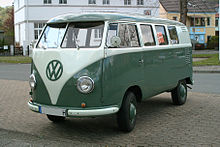
                                                             Volkswagen Type 2 (T1)


    Although the car was becoming outdated, during the 1960s and early 1970s, American exports, innovative advertising, and a growing reputation for reliability helped production figures surpass the levels of the previous record holder, the Ford Model T. On 17 February 1972 the 15,007,034th Beetle was sold. Volkswagen could now claim the world production record for the most-produced, single make of car in history. By 1973, total production was over 16 million.

                                                                                    An original 1300 Deluxe, circa 1966

        To commemorate its passing the Ford Model T's record sales mark and its victories in the Baja 1000 Mexican races from 1967 to 1971, Volkswagen produced its first limited-edition Beetle. It was marketed as the "Baja Champion SE'' in the United States and the "Marathon" Superbeetle in the rest of the world. It featured unique "Marathon Blau" metallic blue paint, steel-pressed 10-spoke 15-inch (38 cm) magnesium-alloy wheels, a commemorative metal plate mounted on the glovebox and a certificate of authenticity presented to the original purchaser. Dealer-installed options for this limited-edition Superbeetle included the following: white stripes running the length of the rocker-panel, a special shifter knob, bumper overriders, tapered exhaust tips, fake walnut inserts in the dashboard (behind the steering wheel and the glovebox cover) as well as Bosch fog lights mounted on the front bumper.

Today, Volkswagen is the largest automaker in Europe. However, it has not always been this way...


     Literally, the word "volkswagen" means "people's car." In Germany, the idea of a people's car wasn't exactly a new one. Before the 1930's, there had been many efforts to create simple cars that everyone could afford, but none met with profound success. Almost all cars before 1930, even if they were designed to be simple enough for the average person, ended up costing more than the average worker's yearly wage.
Ferdinand Porsche    Meanwhile, the year is 1930, and Ferdinand Porsche had just set up an automotive design company, which became known as the Porsche Büro. The company patented a sophisticated independent front suspension system, which consisted of transversely mounted torsion bars connected to two trailing arms on each side. At the time, this was lighter than most other common types of suspension. In 1931, a German motorcycle company, Zündapp, asked Porsche if he could design a suitable car for them. Porsche came up with a streamlined 2 door sedan, which had lines similar to the Beetle. It was designated the Type 12. Zündapp wanted to put in a 1.2 liter radial engine from one of their motorcycles...this was the end of the line for this design, as it didn't make it any further.
    Porsche then designed a car for NSU in 1933 that was known as the Type 32. This car looked even more similar to the upcoming KdF Wagen than the Type 12 did. This car looked similar to the Tatra V570, and shared many mechanical similarities. After World War II, the Volkswagen company paid Tatra for compensation, since Tatra believed its technology and design was pirated in development of the KdF Wagen. Eventaully, NSU dropped the Type 32 project.


     Volkswagen was originally founded in 1937 by the Nazi trade union, the German Labour Front (Deutsche Arbeitsfront). In the early 1930s German auto industry was still largely composed of luxury models, and the average German rarely could afford anything more than a motorcycle. As a result only one German out of 50 owned a car. Seeking a potential new market, some car makers began independent "peoples' car" projects – Mercedes' 170H, Adler's AutoBahn, Steyr 55, Hanomag 1,3L, among others.
The trend was not new, as Béla Barényi is credited with having conceived the basic design in the middle 1920s. Josef Ganz developed the Standard Superior (going as far as advertising it as the "German Volkswagen") . Also, in Czechoslovakia, the Hans Ledwinka's penned Tatra T77, a very popular car amongst the German elite, was becoming smaller and more affordable at each revision. In 1933, with many of the above projects still in development or early stages of production, Adolf Hitler got involved, demanding the production of a basic vehicle capable of transporting two adults and three children at 100 km/h (62 mph). The "People's Car" would be available to citizens of the Third Reich through a savings scheme at 990 Reichsmark (US$ 396 in 1930s dollars)--about the price of a small motorcycle (an average income being around 32RM a week).


                                         Type 12 (Zündapp), Museum of Industrial Culture, Nurnberg

Despite heavy lobbying in favour of one of the existing projects, it soon became apparent that private industry could not turn out a car for only 990RM. Thus, Hitler chose to sponsor an all-new, state-owned factory. The intention was that ordinary Germans would buy the car by means of a savings scheme ("Fünf Mark die Woche musst du sparen, willst du im eigenen Wagen fahren" – "Five marks a week you must put aside, if you want your own car to ride"), which around 336,000 people eventually paid into. Prototypes of the car called the "KdF-Wagen" (German: Kraft durch Freude – "strength through joy"), appeared from 1936 onwards (the first cars had been produced inStuttgart). The car already had its distinctive round shape and air-cooled, flat-four, rear-mounted engine. The VW car was just one of many KdF programs which included things such as tours and outings. The prefix Volks— ("People's") was not just applied to cars, but also to other products in Germany; the "Volksempfänger" radio receiver for instance. On 28 May 1937, the Gesellschaft zur Vorbereitung des Deutschen Volkswagens mbH (sometimes abbreviated to Gezuvor) was established by the Deutsche Arbeitsfront. It was later renamed "Volkswagenwerk GmbH" on 16 September 1938.